Response to Molly Gray’s September 22 Interview on WVMT’s Morning Drive Radio Show
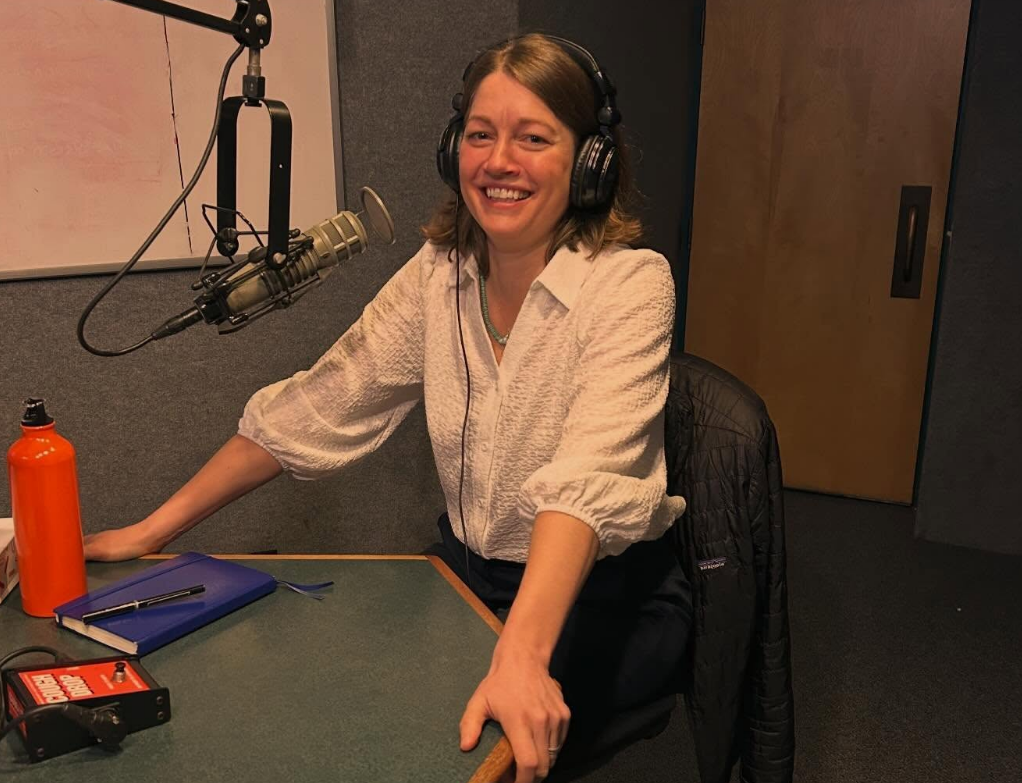
Molly Gray during her April 10 WVMT Morning Drive interview. Photo Credit: mollyforvermont on Instagram
On July 26th, Green Mountain DSA published its August 2026 Primary Guide to give Vermonters a clear record of candidates’ positions on issues affecting working people. Our Electoral Committee sent a ten-question survey to candidates, offered space for additional comments, and published their responses. The guide is separate from our endorsement process.
Molly Gray answered yes to all ten questions.
During her September 22 appearance on WVMT’s The Morning Drive, the hosts questioned Gray about several of those answers. Her responses provided additional information that readers of our guide deserve to see.
On taxing the rich, our questionnaire asked whether candidates supported increasing income taxes on Vermonters making over $250,000 per year AND a wealth-proceeds tax. Gray answered yes. During the interview, however, Gray said she did not agree with a wealth-proceeds tax and would need to review her questionnaire response. Because our question explicitly included both policies, this represents a material difference between her written answer and her subsequent public statement.
On abolishing ICE, our questionnaire asked whether candidates supported abolishing ICE. Gray answered yes. During the interview, she criticized ICE’s current operations but described both abolition and reform as possible approaches. That response leaves her precise position less clear than the affirmative answer published in our guide. It is the position of the chapter that ICE should be completely and wholly abolished and ICE agents who have regularly targeted, harassed, injured and murdered innocent people with impunity be held responsible.
On universal single-payer healthcare, Gray answered yes to fully implementing Act 48 to provide universal single-payer healthcare. On WVMT, she reaffirmed Act 48 as an eventual goal while clarifying universal primary care would be the more immediate step she would pursue. This is an important distinction in policy priorities and timing, but should not be characterized as a rejection of her original support for Act 48.
The interview also included an extended discussion of Proposal 3, Vermont’s proposed constitutional amendment protecting the right to organize and bargain collectively. Proposal 3 was not one of GMDSA’s ten questionnaire questions, but the discussion warrants clarification. The host described the amendment as requiring certain workers to join unions to hold certain jobs. That description conflates two different things: a constitutional protection for negotiated union-security agreements and an automatic requirement that workers join unions.
Proposal 3 would establish a constitutional right to organize and bargain collectively. It would also prevent Vermont from adopting a law prohibiting employers and unions from entering into agreements containing union-membership conditions. It would not itself require every worker, or every worker at a unionized workplace, to become a union member. Such provisions would depend on an negotiated agreement and applicable law.
We also want to address the attempt to discredit Green Mountain DSA and the overall tone of the interview. Throughout the interview, the hosts described GMDSA as a “very far-left organization” and repeatedly questioned what Gray’s agreement with our questionnaire meant for her political identity.
Calling GMDSA ‘very far-left’ tells listeners remarkably little about the policies actually at issue. The policies in our voter guide have majority or near-majority support in national and local polling. Treating agreement with GMDSA positions as self-evident proof that a candidate has moved outside the political mainstream substitutes a label for a discussion of the policies themselves.
We identify openly as democratic socialists. But a label is not a substitute for examining our actual positions, and agreement with a particular policy does not establish membership in, or endorsement by, GMDSA. Members of all three major parties answered the survey.
We also recognize the difficult circumstances Gray faced on the program. Several callers challenged her integrity or motives. One caller had no policy question for Gray, instead asking why she wanted to “hide what she represents” and what she was “afraid of,” before hanging up when Gray asked him to identify a specific issue he wanted to discuss. Meanwhile, the hosts repeatedly returned to political labels and presented Proposal 3 through an inaccurate and misleading description of its effects.
We sympathize with Gray’s experience of that confrontational exchange. We also question an interview framing that placed so much emphasis on whether a candidate could be associated with DSA, rather than consistently examining the wording and implications of the policies themselves.
However, what separates elected leaders who fight for working class issues and those who don’t are those who attempt to play both sides on issues that materially affect working class people and those who proudly refuse to budge on issues they have agreed to fight for.
Our voter guide records what candidates told us at a particular point in time. A later interview may clarify an answer, qualify it, or reveal a change in position. Those possibilities should not be treated as interchangeable. Our purpose is to give Vermonters an accurate record of what candidates have said, including where their positions remain clear and where further explanation is needed.
Workers, voters, and candidates all deserve a discussion grounded in the facts, actual policies, and the public record.